----------
This thread is getting fairly long (as intended) so I figure it might be wise to summarize the contents right up front. It contains write ups and repair work related to the following topics:
- Euro vs. North American hood differences (page 1)
- outer TCA to ARB (anti-roll bar) bushing removal (page 1)
- inner TCA bushing removal (page 1)
- proper torque of the ARB to TCA nut (and what happens if you don't do it right) (page 1)
- hatch lock disassembly, clean up and repair (page 1)
- seat heater repair (page 1)
- stock vs. Group N differential mount differences (page 1)
- defrost and rear wiper switch disassembly and clean up (page 1)
- dome light damage and replacement (page 1 and 3)
- starter/battery cable replacement (page 1)
- starter solenoid failure and autopsy (page 2)
- dash gauge cluster removal (page 3)
- tachometer resoldering (page 3)
- power steering rack bushing removal (page 4)
- power steering high pressure hose installation (page 5)
- power steering system whine-reduction/bleeding (page 5)
- Esslinger timing belt tensioner (page 5)
- Gillis valve manual boost controller installation (page 5)
- J3 adapter chip installation (page 5)
- gas mileage improvement with J3 chip installation (page 6)
- headlamp polishing (page 6)
- Michelin vs. Bosch front wiper blades (page 7)
- center support bearing removal and installation (page 7 and 8)
- guibo replacement (Fiat) (page 8)
- motor mount and transmission mount replacement (Rapido's stuff) (page 9)
- heated seat switch disassembly and cleaning (page 9)
- how to install Group N upper strut insulators (page 9)
- faulty/failing wiper arm linkage repair (page 9)
----------
Where to begin. I purchased a Strato Silver 1987.5 XR4Ti in April 2001. The car was purchased from its second owner with 121,000 miles on it. It was originally equipped with the T9 manual transmission, moonroof and cloth seats.
I've run the car into the ground over the last few years (with regular maintenance along the way), but I've parked it for a total of about 22 months during that time and it's taken a beating in the summer heat. The car is also over 170,000 miles right now and a lot of the original parts are still on the car. A lot of the mechanicals are wearing out and some of the replaced components are ready to get replaced again.
The car is headed for a track event to fill my need to haul ass this summer since my racer is about to go under the knife. I've got to go through a few important systems to get everything up to par. So, I'm going to back up and start talking about this car and then cover the upcoming projects. In the meanwhile, I am going to go jump in the shower. The car was stranded out on the street with a busted starter and I had to remove the ice and snow from under the car in order to jack it up for the starter replacement work. Time to get cleaned up now...
Anglin's Road Car Projects and History

-
anglin
- Level 7

- Posts: 2456
- Joined: Thu Apr 22, 2004 3:20 pm
- Location: Hartford, CT
Anglin's Road Car Projects and History
Last edited by anglin on Tue Oct 06, 2009 12:18 am, edited 7 times in total.
Anglin email: - anglin at mc2racing.com
www.mc2racing.com
www.mc2racing.com
-
anglin
- Level 7
- Posts: 2456
- Joined: Thu Apr 22, 2004 3:20 pm
- Location: Hartford, CT
The previous owner wasn't the nicest to the car. He didn't abuse it terribly, but it wasn't well loved. The car had been autocrossed with a broken driver side motor mount. There was substantial evidence that it had been doing donuts in somebody's lawn in the back bumper and wheel wells. The exhaust system had been completely removed, all the way to the turbo outlet elbow, and had been driven for a short period of time like this (it was much, much quieter than a car with just a downpipe, BTW). Wheels and tires were bolted to it which didn't fit the wheel openings and the car was autocrossed like this.
The previous owner also did a series of engine modifications to it which resulted in the car running mid-13s in the quarter mile. I don't know exactly what the mods were, but it did involve an intercooler and a different computer.
Here's the car at an autocross just prior to my purchase of it:

When I picked the car up, it did have the sticker on the hatch from the dealer it was originally purchased from.

The car also came with a stack of receipts which indicated it had been in two accidents. One of those accidents must have been pretty substantial and involved the right front corner of the car. The car has had the hood replaced and had a junkyard headlamp installed along with some other work that has resulted in some rust development near repairs. The hood that was put on the car was an XR4i hood. You can see that the underhood crash structure is different than North American market cars. Here's the XR4i hood on my car:

The profile is different on the XR4i hood compared to the North American market hood in addition to the crash structure changes. In fact, the European hood has a decidedly more low key look to it compared to the large bulge on the XR4Ti. Frankly, it looks a little puny, and gives a different profile. One of these days I'll line up my two cars side-by-side and snap a hood profile comparison picture to show how the shape varies. Here's a profile shot of the Euro hood:

The Cosworth has the same hood profile, so the Cosworth louvers would fit this hood perfectly.
Here's the crash structure of the North American market hood:

I've had this car for almost 7 years now, so I have a pretty good grip of what is wrong with the car and what repairs and improvements I plan on making to it. That's half the reason why I'm making this thread; because I plan on improving the car. The shell isn't spectacular, as you will see in later pictures, but the car looks okay (from a distance) and it's Strato Silver, which I just happen to be incredibly partial to.
The car turned 140,000 miles while I was driving it on July 4th, 2002.

That odometer is presently displaying about 172,000 miles. The intent is to keep driving this car daily until I'm done with school and have a job that can support the purchase of an E46 M3. That's just about the only car that could replace my Merkur. I'm distracting myself... okay, where was I.
The car has taken quite a bit of abuse by simply being parked for months on end. I've been away from my house for more than two years cumulatively and the car has been parked most of that time. When I returned to my house in November 2003, the original brake calipers weren't so happy about being in one position, so they siezed. I freed them, did some caliper clean up work and replaced the pads and rotors on the car, hoping that the shorter caliper piston travel with the new components would buy me time on those components. It did. It wasn't until January or February 2004 when I was driving a highway and noticed the smell of burning friction material, so the work bought me some time but didn't do anything long term for me. I replaced the calipers shortly after that with items from BAT.

Shortly after that work was done, I did some front suspension work. The car had been exhibiting the single large judder through the steering wheel upon initial application of the brakes. From previous experience, I was aware that this problem stemmed from a worn out TCA to anti-roll bar (sway bar) bushing. When I stripped the suspension off the car I realized just how bad the bushing was.
This is the back-side TCA to ARB bushing on the driver side TCA. It's mostly separated:

This is the front-side TCA to ARB bushing on the driver side TCA. You can see that it is completely separated. The rubber portion of the bushing had pulled completely free of the metal and is laying off to the side in the top right of this picture.

BAT supplied new track control arms on their special deal. The TCAs are actually rebuilds where the ball joint is replaced. Some folks, such as myself, are discovering that these ball joints aren't anywhere near as high quality as the OEM ball joints and are wearing out in much less time. I've noticed profound wear in about two years of driving. BAT charges a small fraction of the new Ford TCAs for these rebuild TCAs, so a cost-benefit analysis may justify these rebuilt TCAs. They do look good though.

You see that they come with the uprated castellated TCA to ARB bushing. Of course, I'd rather upgrade than replace, so those had to go away.
EDIT: another hood picture was added
The previous owner also did a series of engine modifications to it which resulted in the car running mid-13s in the quarter mile. I don't know exactly what the mods were, but it did involve an intercooler and a different computer.
Here's the car at an autocross just prior to my purchase of it:
When I picked the car up, it did have the sticker on the hatch from the dealer it was originally purchased from.
The car also came with a stack of receipts which indicated it had been in two accidents. One of those accidents must have been pretty substantial and involved the right front corner of the car. The car has had the hood replaced and had a junkyard headlamp installed along with some other work that has resulted in some rust development near repairs. The hood that was put on the car was an XR4i hood. You can see that the underhood crash structure is different than North American market cars. Here's the XR4i hood on my car:
The profile is different on the XR4i hood compared to the North American market hood in addition to the crash structure changes. In fact, the European hood has a decidedly more low key look to it compared to the large bulge on the XR4Ti. Frankly, it looks a little puny, and gives a different profile. One of these days I'll line up my two cars side-by-side and snap a hood profile comparison picture to show how the shape varies. Here's a profile shot of the Euro hood:
The Cosworth has the same hood profile, so the Cosworth louvers would fit this hood perfectly.
Here's the crash structure of the North American market hood:
I've had this car for almost 7 years now, so I have a pretty good grip of what is wrong with the car and what repairs and improvements I plan on making to it. That's half the reason why I'm making this thread; because I plan on improving the car. The shell isn't spectacular, as you will see in later pictures, but the car looks okay (from a distance) and it's Strato Silver, which I just happen to be incredibly partial to.
The car turned 140,000 miles while I was driving it on July 4th, 2002.
That odometer is presently displaying about 172,000 miles. The intent is to keep driving this car daily until I'm done with school and have a job that can support the purchase of an E46 M3. That's just about the only car that could replace my Merkur. I'm distracting myself... okay, where was I.
The car has taken quite a bit of abuse by simply being parked for months on end. I've been away from my house for more than two years cumulatively and the car has been parked most of that time. When I returned to my house in November 2003, the original brake calipers weren't so happy about being in one position, so they siezed. I freed them, did some caliper clean up work and replaced the pads and rotors on the car, hoping that the shorter caliper piston travel with the new components would buy me time on those components. It did. It wasn't until January or February 2004 when I was driving a highway and noticed the smell of burning friction material, so the work bought me some time but didn't do anything long term for me. I replaced the calipers shortly after that with items from BAT.
Shortly after that work was done, I did some front suspension work. The car had been exhibiting the single large judder through the steering wheel upon initial application of the brakes. From previous experience, I was aware that this problem stemmed from a worn out TCA to anti-roll bar (sway bar) bushing. When I stripped the suspension off the car I realized just how bad the bushing was.
This is the back-side TCA to ARB bushing on the driver side TCA. It's mostly separated:
This is the front-side TCA to ARB bushing on the driver side TCA. You can see that it is completely separated. The rubber portion of the bushing had pulled completely free of the metal and is laying off to the side in the top right of this picture.
BAT supplied new track control arms on their special deal. The TCAs are actually rebuilds where the ball joint is replaced. Some folks, such as myself, are discovering that these ball joints aren't anywhere near as high quality as the OEM ball joints and are wearing out in much less time. I've noticed profound wear in about two years of driving. BAT charges a small fraction of the new Ford TCAs for these rebuild TCAs, so a cost-benefit analysis may justify these rebuilt TCAs. They do look good though.
You see that they come with the uprated castellated TCA to ARB bushing. Of course, I'd rather upgrade than replace, so those had to go away.
EDIT: another hood picture was added
Last edited by anglin on Thu Dec 20, 2007 4:38 pm, edited 2 times in total.
Anglin email: - anglin at mc2racing.com
www.mc2racing.com
www.mc2racing.com


-
anglin
- Level 7
- Posts: 2456
- Joined: Thu Apr 22, 2004 3:20 pm
- Location: Hartford, CT
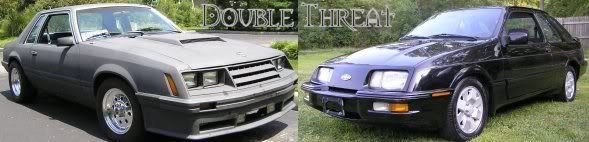
They are definitely decent looking wheels. If I remember the previous owner's description of them correctly, they are from a late 80s vintage Saleen Mustang. He didn't sell them to me with the car.EVIL_XR4 wrote:I think those wheels need to find their way onto my car
I shall continue.
I prefer to upgrade, so with the TCA replacement, I opted for polyurethane bushings at the TCA to ARB connection and the inner TCA connection. mc²racing was not yet a supplier of Powerflex polyurethane bushings, so I opted for BAT's poly stuff and extracted the rubber stuff from the TCA.
I don't know if a picture has ever been posted of this process, but here is how I removed the TCA to ARB bushing. The split metal center sleeves are visible in this picture, which shows that there is a front half and a back half to the TCA bushing pair.

Just working a screwdriver in on the metal lip on the edge pops out one half of the bushing.

Once it starts to work free of the TCA, you can really get under the edge and work it out.

Once the TCA bushing is out, you can see what I mean by front and back halves.


Profile of the castellated design of the improved TCA to ARB bushing.

The next step was to extract the inner TCA bushings. Using some combination of different-sized sockets and a vise, I pushed them out. This is the right small socket, but the wrong large socket.

You can see that it doesn't get you very far. You need one large enough to press against the TCA itself, not the TCA bushing.

Once you get the right combination of socket sizes, success is easy.

Last edited by anglin on Thu Dec 20, 2007 9:14 pm, edited 1 time in total.
Anglin email: - anglin at mc2racing.com
www.mc2racing.com
www.mc2racing.com
-
anglin
- Level 7
- Posts: 2456
- Joined: Thu Apr 22, 2004 3:20 pm
- Location: Hartford, CT
Now that the TCA is free of rubber bushings, it is much easier to install the polyurethane bushings. I found impossible to put the poly bushings in before taking the rubber bushings out.
I'm kidding.
Here's the TCA to ARB hole waiting to be filled.

TCAs waiting on the polyurethane.

Poly bushings installed and the TCAs are ready to be installed into the car.

The really great thing about the polyurethane TCA to ARB bushings is the elimination of the final and very annoying step of front suspension assembly. The large nut on the end of the anti-roll bar (sway bar) cannot be torque until the weight of the car is resting on the front suspension. If you torque the nut with the suspension in the air it clamps the TCA bushing in place. Then you set the front suspension on the ground and it moves to a new equilibrium position and twists the bonded rubber. The rubber stays under stress at all times resulting in premature failure of the bushing.
Here's the TCA to ARB bushing on a customer car. These TCAs had only been in the car for about 200 miles of road use and already you can see the damage from the bushing being twisted.

The polyurethane bushings in the TCA to ARB position have a center sleeve which is NOT bonded to the bushing itself. This allows it to rotate freely preventing damage like in the picture above and ELIMINATES the requirement to torque the anti-roll bar nut while the car's weight is resting on the front suspension. Yay for upgraded bushings!
Of course, not all projects are mechanical. I try to keep the engine bay as clean as possible simply because I feel more motivated to work on the car when the engine compartment isn't disgusting.
Before and after some engine compartment clean up work (the differences are subtle from this camera angle).


When I got the car, I spent some time replacing hoses and getting everything ready for use as my road car. I removed the heater control valve as a part of other work that was happening when I was getting the car into shape. Here are pictures of the results:


Here is something you don't see much of on the XR4Ti throttle body anymore; the Ford emblem.

It has fallen off since that picture was taken.
I'm kidding.
Here's the TCA to ARB hole waiting to be filled.
TCAs waiting on the polyurethane.
Poly bushings installed and the TCAs are ready to be installed into the car.
The really great thing about the polyurethane TCA to ARB bushings is the elimination of the final and very annoying step of front suspension assembly. The large nut on the end of the anti-roll bar (sway bar) cannot be torque until the weight of the car is resting on the front suspension. If you torque the nut with the suspension in the air it clamps the TCA bushing in place. Then you set the front suspension on the ground and it moves to a new equilibrium position and twists the bonded rubber. The rubber stays under stress at all times resulting in premature failure of the bushing.
Here's the TCA to ARB bushing on a customer car. These TCAs had only been in the car for about 200 miles of road use and already you can see the damage from the bushing being twisted.
The polyurethane bushings in the TCA to ARB position have a center sleeve which is NOT bonded to the bushing itself. This allows it to rotate freely preventing damage like in the picture above and ELIMINATES the requirement to torque the anti-roll bar nut while the car's weight is resting on the front suspension. Yay for upgraded bushings!
Of course, not all projects are mechanical. I try to keep the engine bay as clean as possible simply because I feel more motivated to work on the car when the engine compartment isn't disgusting.
Before and after some engine compartment clean up work (the differences are subtle from this camera angle).
When I got the car, I spent some time replacing hoses and getting everything ready for use as my road car. I removed the heater control valve as a part of other work that was happening when I was getting the car into shape. Here are pictures of the results:
Here is something you don't see much of on the XR4Ti throttle body anymore; the Ford emblem.
It has fallen off since that picture was taken.
Last edited by anglin on Thu Dec 20, 2007 9:18 pm, edited 1 time in total.
Anglin email: - anglin at mc2racing.com
www.mc2racing.com
www.mc2racing.com
-
anglin
- Level 7
- Posts: 2456
- Joined: Thu Apr 22, 2004 3:20 pm
- Location: Hartford, CT
One of the things that I have decided must be integral with my ownership and year-round driving of an XR4Ti is a modern set of snow tires. I'm presently using a set of Michelin X-Ice snow tires with the ice-compound rubber. I'm always amazed at their performance and believe that it's critical for safety. I'm so convinced that I purchased a set of snow tires for the WRX this year. That car should be amazing with the AWD and the snow tires. It was pretty impressive before.
Back to the topic. Like usual, a few winters ago I waited too late to put snow tires on the XR, so I took it to my place of employment at the time, a large warehouse, and did the installation of the snow tires there. I was a supervisor so had 24 hour access to the facility. I put the equipment to good use as well.


The end result works out to be just about like this; it snows, you put the snow tires on, the snow melts and it doesn't snow again for a long time.

While I had the vehicle in the warehouse, I took some other entertaining pictures.


Back to the topic. Like usual, a few winters ago I waited too late to put snow tires on the XR, so I took it to my place of employment at the time, a large warehouse, and did the installation of the snow tires there. I was a supervisor so had 24 hour access to the facility. I put the equipment to good use as well.
The end result works out to be just about like this; it snows, you put the snow tires on, the snow melts and it doesn't snow again for a long time.
While I had the vehicle in the warehouse, I took some other entertaining pictures.
Anglin email: - anglin at mc2racing.com
www.mc2racing.com
www.mc2racing.com
-
anglin
- Level 7
- Posts: 2456
- Joined: Thu Apr 22, 2004 3:20 pm
- Location: Hartford, CT
The hatch lock stopped functioning a few years ago. In fact, it jammed, so I wasn't able to open the hatch at all. I had to crawl in through the back seat and disassemble the lock mechanism with the hatch closed. Once I got it out, I discovered that my lock housing had succumbed to the standard XR4Ti failure of the powdered metal. Here is the series of pictures from disassembly and clean up.
The lock mechanism as it was removed:

The cracked housing:

Lock components after disassembly:

The failure point:

Pushing the lock cylinder through the housing:

The crusty o-ring that seals the assembly:

The o-ring after it has been extracted:

The o-ring and the lock housing and its o-ring groove cleaned up for reassembly:

Cleaned and reassembled:

I reinstalled the snap ring so that it would maximize its bearing area to avoid another failure. It didn't work and the lock assembly came apart again shortly after putting it back in the car. The reassembled lock assembly:

The only permanent fix would be to replace the housing. I could use another stock housing and wait for it to break, or I could have one machined out of something more sturdy. Either way, I keep nothing of value in the car (literally) so I am not terribly worried about this for the time being.
The lock mechanism as it was removed:
The cracked housing:
Lock components after disassembly:
The failure point:
Pushing the lock cylinder through the housing:
The crusty o-ring that seals the assembly:
The o-ring after it has been extracted:
The o-ring and the lock housing and its o-ring groove cleaned up for reassembly:
Cleaned and reassembled:
I reinstalled the snap ring so that it would maximize its bearing area to avoid another failure. It didn't work and the lock assembly came apart again shortly after putting it back in the car. The reassembled lock assembly:
The only permanent fix would be to replace the housing. I could use another stock housing and wait for it to break, or I could have one machined out of something more sturdy. Either way, I keep nothing of value in the car (literally) so I am not terribly worried about this for the time being.
Anglin email: - anglin at mc2racing.com
www.mc2racing.com
www.mc2racing.com
-
anglin
- Level 7
- Posts: 2456
- Joined: Thu Apr 22, 2004 3:20 pm
- Location: Hartford, CT
The car was equipped with heated seats. In Ohio, that option is very usable from October to April or even May. However, the wiring in the seat back has a tendency break after years of flipping the seat forward. When I started carpooling with a buddy to work each day and I realized the heated seat on his side was working and mine wasn't, I got jealous enough to remove the driver's seat and tear it apart. I'm so glad I did.
Seat back viewed from the bottom after it was unbolted from the seat bottom:

These little hooks have to be bent back to release the fabric:

Once the fabric is pulled back, you can see the seat heater pad, still on the hooks:

The break in the wiring becomes VERY obvious when the heater pad is released from the hooks:

The wiring should disappear back into the heater pad right here:

Here's a shot of the entire seat back so you know where the work is taking place:

After digging around in the seat heater pad a little bit, these wires are easily extracted. A little bit of work with the wires and everything is hooked back up and the heated seats work again. Amazing!

The heater core in the car isn't perfect, so the heated seats definitely help in the winter time. I have really come to appreciate them and I definitely miss them in the WRX when I'm driving/riding in that car during the chilly months.
Seat back viewed from the bottom after it was unbolted from the seat bottom:
These little hooks have to be bent back to release the fabric:
Once the fabric is pulled back, you can see the seat heater pad, still on the hooks:
The break in the wiring becomes VERY obvious when the heater pad is released from the hooks:
The wiring should disappear back into the heater pad right here:
Here's a shot of the entire seat back so you know where the work is taking place:
After digging around in the seat heater pad a little bit, these wires are easily extracted. A little bit of work with the wires and everything is hooked back up and the heated seats work again. Amazing!
The heater core in the car isn't perfect, so the heated seats definitely help in the winter time. I have really come to appreciate them and I definitely miss them in the WRX when I'm driving/riding in that car during the chilly months.
Anglin email: - anglin at mc2racing.com
www.mc2racing.com
www.mc2racing.com
-
anglin
- Level 7
- Posts: 2456
- Joined: Thu Apr 22, 2004 3:20 pm
- Location: Hartford, CT
Not all of the work that has been done to the car is restoration and repair. Some performance work has been done as well. The fuel pump was on its last leg when I got the car, but I kept driving it. In 2005, I decided that I was tired of the fuel pump problems and decided to upgrade to the Walbro in-tank 255 lph pump. Of course I failed to reconnect the ground wire for the fuel level sender, so I have to drop the tank again (I've just been putting up with it since then, but I am no longer happy to do so).
Additionally, I installed a Group-N rubber differential mount. I was amazed at the increase in performance from this part. The rear end of the car handles quick transitional changes much more quickly now. I got one of the last new Group-N mounts available, so I am part of the reason why the polyurethane and aluminum diff mount exists.
The original mount:

The Group-N mount:

The standard part lacks that metal plate in the rubber between the center section and the outer section:

Some of the recent work I have done to the car involves improvements in function. Over the years of existence, the rear defrost switch and the rear wiper switch have become so gummed up that they became almost impossible to operate in cold weather. I took the switches out of the car and disassebled them in the house. I cleaned the contacts, removed the old lubricant and replaced it with new lube. The operation now, even in 20 degree weather is flawless.
Defrost switch disassembled:

Defrost internal mechanism:

Defrost switch contact:

Rear wiper switch internals:

The seat heater switches, which worked well enough prior to my recent deployment, are now acting sluggishly, so they are going to get cleaned as well. I am also very dissatisfied with the turn signal switch operation, so I'll be taking that apart as well in the near future.
Additionally, I installed a Group-N rubber differential mount. I was amazed at the increase in performance from this part. The rear end of the car handles quick transitional changes much more quickly now. I got one of the last new Group-N mounts available, so I am part of the reason why the polyurethane and aluminum diff mount exists.
The original mount:
The Group-N mount:
The standard part lacks that metal plate in the rubber between the center section and the outer section:
Some of the recent work I have done to the car involves improvements in function. Over the years of existence, the rear defrost switch and the rear wiper switch have become so gummed up that they became almost impossible to operate in cold weather. I took the switches out of the car and disassebled them in the house. I cleaned the contacts, removed the old lubricant and replaced it with new lube. The operation now, even in 20 degree weather is flawless.
Defrost switch disassembled:
Defrost internal mechanism:
Defrost switch contact:
Rear wiper switch internals:
The seat heater switches, which worked well enough prior to my recent deployment, are now acting sluggishly, so they are going to get cleaned as well. I am also very dissatisfied with the turn signal switch operation, so I'll be taking that apart as well in the near future.
Last edited by anglin on Thu Dec 20, 2007 9:23 pm, edited 1 time in total.
Anglin email: - anglin at mc2racing.com
www.mc2racing.com
www.mc2racing.com
-
anglin
- Level 7
- Posts: 2456
- Joined: Thu Apr 22, 2004 3:20 pm
- Location: Hartford, CT
Speaking of the deployment... The body of the car has been lacking in quality of appearance. That's a nice way of saying that it is the rustiest Merkur I've ever owned. Being gone for 14 months allowed me the opportunity to chart the spread of the rust in the car.
Here's some wheel arch rust in August 2006:

And here's the same rust in November 2007:

The angle and lighting differences do make it a little bit difficult to see the magnitude of the changes, but you can definitely see the change. Time for some body work, I guess.
Of course, the car remained closed for almost the entire summer. which was a pretty hot one compared to normal (we can only confess to calling it "global climate change" though... if we used the word "warming" we'd be admitting to something... and we CAN'T have that). The heat absolutely DESTROYS the dome light plastic. This will crumble in my hands like a chunk of sugar lightly stuck together by some humidity.

It looks like this is all I have for the time being. It's time to move onto other projects today. I've got some work to do to the car, so I'd better take advantage of the light while I've got it.
Stay tuned for updates and work and pictures of this car that I stumble across.
Here's some wheel arch rust in August 2006:
And here's the same rust in November 2007:
The angle and lighting differences do make it a little bit difficult to see the magnitude of the changes, but you can definitely see the change. Time for some body work, I guess.
Of course, the car remained closed for almost the entire summer. which was a pretty hot one compared to normal (we can only confess to calling it "global climate change" though... if we used the word "warming" we'd be admitting to something... and we CAN'T have that). The heat absolutely DESTROYS the dome light plastic. This will crumble in my hands like a chunk of sugar lightly stuck together by some humidity.
It looks like this is all I have for the time being. It's time to move onto other projects today. I've got some work to do to the car, so I'd better take advantage of the light while I've got it.
Stay tuned for updates and work and pictures of this car that I stumble across.
Last edited by anglin on Thu Dec 20, 2007 9:24 pm, edited 1 time in total.
Anglin email: - anglin at mc2racing.com
www.mc2racing.com
www.mc2racing.com
-
Ray

- Level 7
- Posts: 4338
- Joined: Sun Oct 24, 2004 10:40 am
- Location: CT, USA
Your detailed pictures will help untold numbers of enthusiasts who are DIY'ers.
Thank you Mr. Anglin.
Thank you Mr. Anglin.
-Ray
1985 Ford F150 - Tow Missile
1985 Merkur XR4Ti -#141 CP "Miss Daisy"
2005 Subaru LGT
http://www.cartct.com
1985 Ford F150 - Tow Missile
1985 Merkur XR4Ti -#141 CP "Miss Daisy"
2005 Subaru LGT
http://www.cartct.com
-
anglin
- Level 7
- Posts: 2456
- Joined: Thu Apr 22, 2004 3:20 pm
- Location: Hartford, CT
So, I was driving along in my road car tonight, minding my own business, and I realized the clutch pedal seemed to engage/disengage the clutch kinda high up on the pedal travel. Then it hit me... I've put a Godfrey clutch adjuster (first version) in that car. I completely forgot about that.
Here's a picture of it, originally posted to the MerkurTech.com Picture Page (MTPP):

That's the adjuster prior to installation.
Here's a picture of it, originally posted to the MerkurTech.com Picture Page (MTPP):
That's the adjuster prior to installation.
Anglin email: - anglin at mc2racing.com
www.mc2racing.com
www.mc2racing.com
-
anglin
- Level 7
- Posts: 2456
- Joined: Thu Apr 22, 2004 3:20 pm
- Location: Hartford, CT
I know this stuff is way less interesting than some of the other stuff that gets posted here, but I am going to keep annoying you with mundane projects anyway.
One of my expectations when I came back from Iraq was that my car wasn't going to be as reliable as it was when I left. Bad things happen when a car sits for months at a time. Last time I went away for an extended period of time, the braking system was the issue. This time it was the starter and (or) the electrical system.
As the temperature dropped the car became nearly impossible to start. When I'd turn the key, I could hear the starter solenoid actuating, but the engine wasn't cranking. The starter wasn't spinning either (that I could hear) so it wasn't as though the gear was turning but wasn't being pushed out to engage the flywheel. If I tried the key enough times, eventually the starter would work and the car would start. So, the car was still getting me around but I was never sure that it was going start for me the next time I needed it to start.
I'm back in school now carrying a large load of enginering and math classes (full time and a half) and, frankly, it's kicking my ass. I haven't attended classes because of my deployment since May 2006 and my brain paid the price. It took me 30 minutes to recall how to perform simple integrals. I'm going to school first thing in the morning and I'm often there until 8 or 9 pm, so a car that isn't guaranteed to start wasn't helping. Unfortunately, Connie's schedule prevented sensible use of one car for both of us and the car "ran" just enough. It never once left me stranded.
The symptoms were very odd. It seemed to take more attempts to start when it was colder. I usually start the car in neutral, so I leave the clutch pedal alone. However, there seemed to be some correlation between pressing in the clutch pedal and the car starting. This lead me to think that the starter was getting current, just not enough to turn the engine and the transmission on the cold days. Initially I thought the old trick of rapping on the starter body with a hammer might help. I never got any proof that it did. I'd turn the key four or five times with no luck, rap on the starter and then turn it two or three more times and it would start. That it definitely not proof that the hammer trick was helping the problem.
Now, I replaced the original starter at the beginning of the year with a starter that I had in my parts pile because I was having a similar starting problem. That problem was more like the starter wasn't fully engaging. There would be a terrible ratcheting sound when the engine was cranked but the engine would turn and start. Replacing that starter with the used starter from my stash fixed the problem initially.
To summarize, I replaced the original starter at the beginning of the year with a used starter which temporarily helped. Then that replacement starter started having problems shortly after that. The symptoms seemed to point at electrical problems but, just like the hammer trick, there was no proof that it was only an electrical problem.
The problem reared its head last Monday, so of course I'm much too busy at that point to get anything done about it with homework due and stuff to study. This weekend was my first good option to work on it and the weather forecast put us in the teens and I've got no garage. Thankfully, my brother-in-law has a 4-car heated garage and he was gracious enough to loan it to me.
The end result of my work yesterday says that it was likely a combination of both an electrical problem and a starter that really wasn't up to the task of starting the car. With that said, I can now share the pictures.
I did a lot of cleaning (wire-brushing) of the electrical terminals and the grounds. None of that seemed to make a difference.

When I was cleaning the positive battery cable that connects to the starter solenoid I noticed the cable ends weren't in very good condition where they connected to the cable itself.
Here's the PN of the 21 year old cable (E6RD-14300-AA):

Other than some discoloration and loom tubing that was brittle in some spots, it looked to be in decent shape. Here's the entire cable.

I've messed with the tubing covering the wire at the left end a little bit already and you can see that the cable isn't in the best shape. I had no idea what I was going to find once I started to remove the loom tubing.

That spiral crack you see in the above picture is just the beginning. The four cracks you see are actually one continuous spiral around the insulation. Now here's where it gets really bad - the other end of that cable.

I measured the electrical resistance of that cable. The total resistance for that 18 inch long cable was right around 13.4 ohms. According to Ray, it should be right about 0.2 ohms, so it had 67 times more electrical resistance than it should have had. By Ohm's Law, the cable itself was absorbing about 1 amp of current.
Autozone had a part on the shelf that was mostly a direct replacement (DW419B).

That cable (4 gauge, 19 inches in length with lug ends) was about $4 and was slightly longer than stock. Of course, Autozone is keeping inventory costs down by only making black cables available, so I couldn't use a sensible replacement in red. They also didn't have a spool of battery cable to buy lengths of cable from. WTF?
I considered replacing the lug on one end with the stock lug for the OEM flag terminals for an OEM look. My car has a top post battery with "marine" terminal connectors on it, so I have just used the OEM flag terminals with no problem. I wanted to keep that arrangement, so the lug ends worked well.
After seeing that, I didn't hold much hope for the cable that connects the solenoid to the starter itself. It wasn't in great condition, but the measured resistance was at an acceptable value (0.3 to 0.6 ohms) and the insulation was in much better shape. The worst spot was right near the lug that bolts to the starter.

I replaced that cable as well (DW460B) with another black (ugh) cable; 4-gauge, 60 inches long with lug ends for about $10. It was about 4 inches longer than stock, so I shortened it by about 2 inches and put the OEM starter lug on it from the old cable. I also put that "hanger" on the replacement cable so that it was firmly held to the block at the same location as the ground point for the battery negative to block.
Here's the stock solenoid to starter cable in its OEM configuration with the stock negative battery terminal to engine ground.

I considered replacing the battery ground cable but the insulation and ends were in good shape and its measured resistance was about 0.3 ohms and the resistance between the negative post on the battery was 0.0 ohms on the smallest scale my ohmmeter would read to (20 ohms).
Frankly, the work I did was not satisfactory to me. Okay, the execution was good enough, but there are several details about the task which annoyed me. I wanted the work to look much more OEM with loom tubing and better end lugs. The fact that I used black cable instead of red for positive-terminal applications annoys the F out of me. I guess this is what happens when you are working in somebody else's garage 30 miles from your own pseudo-garage and don't have the tools you are used to having.
Here's the Ford PN for the starter solenoid (E5DF-11450-AA):

So, the car cranks when I want it to now. I'm much happier and I can carry on feeling comfortable that my car is much more reliable now.
On an unrelated note - while I had the car in the air to replace the starter, I did an inspection of the front suspension. The suspension is going to receive a rebuild soon because I have plans to haul ass around Mid-Ohio with it later this year ( http://forum.merkurclub.com/forum/viewtopic.php?t=10535 ) so I was checking on some of the previously conducted work so I could get a good assessment. I checked the deflection of the wheels in several directions. I discovered something rather disturbing about the OEM power steering rack bushings. I can actually visibly move the steering rack around quite easily with moderate force on the wheel. It doesn't move much, but I could see it with my eyes, so that is too much. Needless to say, they are now on the list to be replaced when I go through the front suspension in a few months.
One of my expectations when I came back from Iraq was that my car wasn't going to be as reliable as it was when I left. Bad things happen when a car sits for months at a time. Last time I went away for an extended period of time, the braking system was the issue. This time it was the starter and (or) the electrical system.
As the temperature dropped the car became nearly impossible to start. When I'd turn the key, I could hear the starter solenoid actuating, but the engine wasn't cranking. The starter wasn't spinning either (that I could hear) so it wasn't as though the gear was turning but wasn't being pushed out to engage the flywheel. If I tried the key enough times, eventually the starter would work and the car would start. So, the car was still getting me around but I was never sure that it was going start for me the next time I needed it to start.
I'm back in school now carrying a large load of enginering and math classes (full time and a half) and, frankly, it's kicking my ass. I haven't attended classes because of my deployment since May 2006 and my brain paid the price. It took me 30 minutes to recall how to perform simple integrals. I'm going to school first thing in the morning and I'm often there until 8 or 9 pm, so a car that isn't guaranteed to start wasn't helping. Unfortunately, Connie's schedule prevented sensible use of one car for both of us and the car "ran" just enough. It never once left me stranded.
The symptoms were very odd. It seemed to take more attempts to start when it was colder. I usually start the car in neutral, so I leave the clutch pedal alone. However, there seemed to be some correlation between pressing in the clutch pedal and the car starting. This lead me to think that the starter was getting current, just not enough to turn the engine and the transmission on the cold days. Initially I thought the old trick of rapping on the starter body with a hammer might help. I never got any proof that it did. I'd turn the key four or five times with no luck, rap on the starter and then turn it two or three more times and it would start. That it definitely not proof that the hammer trick was helping the problem.
Now, I replaced the original starter at the beginning of the year with a starter that I had in my parts pile because I was having a similar starting problem. That problem was more like the starter wasn't fully engaging. There would be a terrible ratcheting sound when the engine was cranked but the engine would turn and start. Replacing that starter with the used starter from my stash fixed the problem initially.
To summarize, I replaced the original starter at the beginning of the year with a used starter which temporarily helped. Then that replacement starter started having problems shortly after that. The symptoms seemed to point at electrical problems but, just like the hammer trick, there was no proof that it was only an electrical problem.
The problem reared its head last Monday, so of course I'm much too busy at that point to get anything done about it with homework due and stuff to study. This weekend was my first good option to work on it and the weather forecast put us in the teens and I've got no garage. Thankfully, my brother-in-law has a 4-car heated garage and he was gracious enough to loan it to me.
The end result of my work yesterday says that it was likely a combination of both an electrical problem and a starter that really wasn't up to the task of starting the car. With that said, I can now share the pictures.
I did a lot of cleaning (wire-brushing) of the electrical terminals and the grounds. None of that seemed to make a difference.
When I was cleaning the positive battery cable that connects to the starter solenoid I noticed the cable ends weren't in very good condition where they connected to the cable itself.
Here's the PN of the 21 year old cable (E6RD-14300-AA):
Other than some discoloration and loom tubing that was brittle in some spots, it looked to be in decent shape. Here's the entire cable.
I've messed with the tubing covering the wire at the left end a little bit already and you can see that the cable isn't in the best shape. I had no idea what I was going to find once I started to remove the loom tubing.
That spiral crack you see in the above picture is just the beginning. The four cracks you see are actually one continuous spiral around the insulation. Now here's where it gets really bad - the other end of that cable.
I measured the electrical resistance of that cable. The total resistance for that 18 inch long cable was right around 13.4 ohms. According to Ray, it should be right about 0.2 ohms, so it had 67 times more electrical resistance than it should have had. By Ohm's Law, the cable itself was absorbing about 1 amp of current.
Autozone had a part on the shelf that was mostly a direct replacement (DW419B).
That cable (4 gauge, 19 inches in length with lug ends) was about $4 and was slightly longer than stock. Of course, Autozone is keeping inventory costs down by only making black cables available, so I couldn't use a sensible replacement in red. They also didn't have a spool of battery cable to buy lengths of cable from. WTF?
I considered replacing the lug on one end with the stock lug for the OEM flag terminals for an OEM look. My car has a top post battery with "marine" terminal connectors on it, so I have just used the OEM flag terminals with no problem. I wanted to keep that arrangement, so the lug ends worked well.
After seeing that, I didn't hold much hope for the cable that connects the solenoid to the starter itself. It wasn't in great condition, but the measured resistance was at an acceptable value (0.3 to 0.6 ohms) and the insulation was in much better shape. The worst spot was right near the lug that bolts to the starter.
I replaced that cable as well (DW460B) with another black (ugh) cable; 4-gauge, 60 inches long with lug ends for about $10. It was about 4 inches longer than stock, so I shortened it by about 2 inches and put the OEM starter lug on it from the old cable. I also put that "hanger" on the replacement cable so that it was firmly held to the block at the same location as the ground point for the battery negative to block.
Here's the stock solenoid to starter cable in its OEM configuration with the stock negative battery terminal to engine ground.
I considered replacing the battery ground cable but the insulation and ends were in good shape and its measured resistance was about 0.3 ohms and the resistance between the negative post on the battery was 0.0 ohms on the smallest scale my ohmmeter would read to (20 ohms).
Frankly, the work I did was not satisfactory to me. Okay, the execution was good enough, but there are several details about the task which annoyed me. I wanted the work to look much more OEM with loom tubing and better end lugs. The fact that I used black cable instead of red for positive-terminal applications annoys the F out of me. I guess this is what happens when you are working in somebody else's garage 30 miles from your own pseudo-garage and don't have the tools you are used to having.
Here's the Ford PN for the starter solenoid (E5DF-11450-AA):
So, the car cranks when I want it to now. I'm much happier and I can carry on feeling comfortable that my car is much more reliable now.
On an unrelated note - while I had the car in the air to replace the starter, I did an inspection of the front suspension. The suspension is going to receive a rebuild soon because I have plans to haul ass around Mid-Ohio with it later this year ( http://forum.merkurclub.com/forum/viewtopic.php?t=10535 ) so I was checking on some of the previously conducted work so I could get a good assessment. I checked the deflection of the wheels in several directions. I discovered something rather disturbing about the OEM power steering rack bushings. I can actually visibly move the steering rack around quite easily with moderate force on the wheel. It doesn't move much, but I could see it with my eyes, so that is too much. Needless to say, they are now on the list to be replaced when I go through the front suspension in a few months.
Anglin email: - anglin at mc2racing.com
www.mc2racing.com
www.mc2racing.com
-
DPDISXR4Ti

- Site Admin
- Posts: 15622
- Joined: Wed Jan 08, 2003 11:40 pm
- Location: New York
"When good cables go bad", now available at a bookstore near you!
I never used to put much faith in the suggestion to "replace the cables" until I experienced a failure similar to what Chris experienced here. FWIW, it was actually on the Brat, when it still ran as an original Brat - the insulation even looked fine, so it didn't even have the tell-tale cracks as shown above, but the cable was internally corroded and providing a significant voltage drop.
Today's lesson.... If you still have original cables on the car still, it would be a good idea to just pro-actively replace them as a maintenance procedure.
I never used to put much faith in the suggestion to "replace the cables" until I experienced a failure similar to what Chris experienced here. FWIW, it was actually on the Brat, when it still ran as an original Brat - the insulation even looked fine, so it didn't even have the tell-tale cracks as shown above, but the cable was internally corroded and providing a significant voltage drop.
Today's lesson.... If you still have original cables on the car still, it would be a good idea to just pro-actively replace them as a maintenance procedure.
Brad
-
Ray
- Level 7
- Posts: 4338
- Joined: Sun Oct 24, 2004 10:40 am
- Location: CT, USA
13 ohms, wild.
Replacing wires is probably one of the first things i would do to a new to me but old car.
Replacing wires is probably one of the first things i would do to a new to me but old car.
-Ray
1985 Ford F150 - Tow Missile
1985 Merkur XR4Ti -#141 CP "Miss Daisy"
2005 Subaru LGT
http://www.cartct.com
1985 Ford F150 - Tow Missile
1985 Merkur XR4Ti -#141 CP "Miss Daisy"
2005 Subaru LGT
http://www.cartct.com